The Next Frontier of Compute: Inside NVIDIA’s Revolutionary New AI GPUs
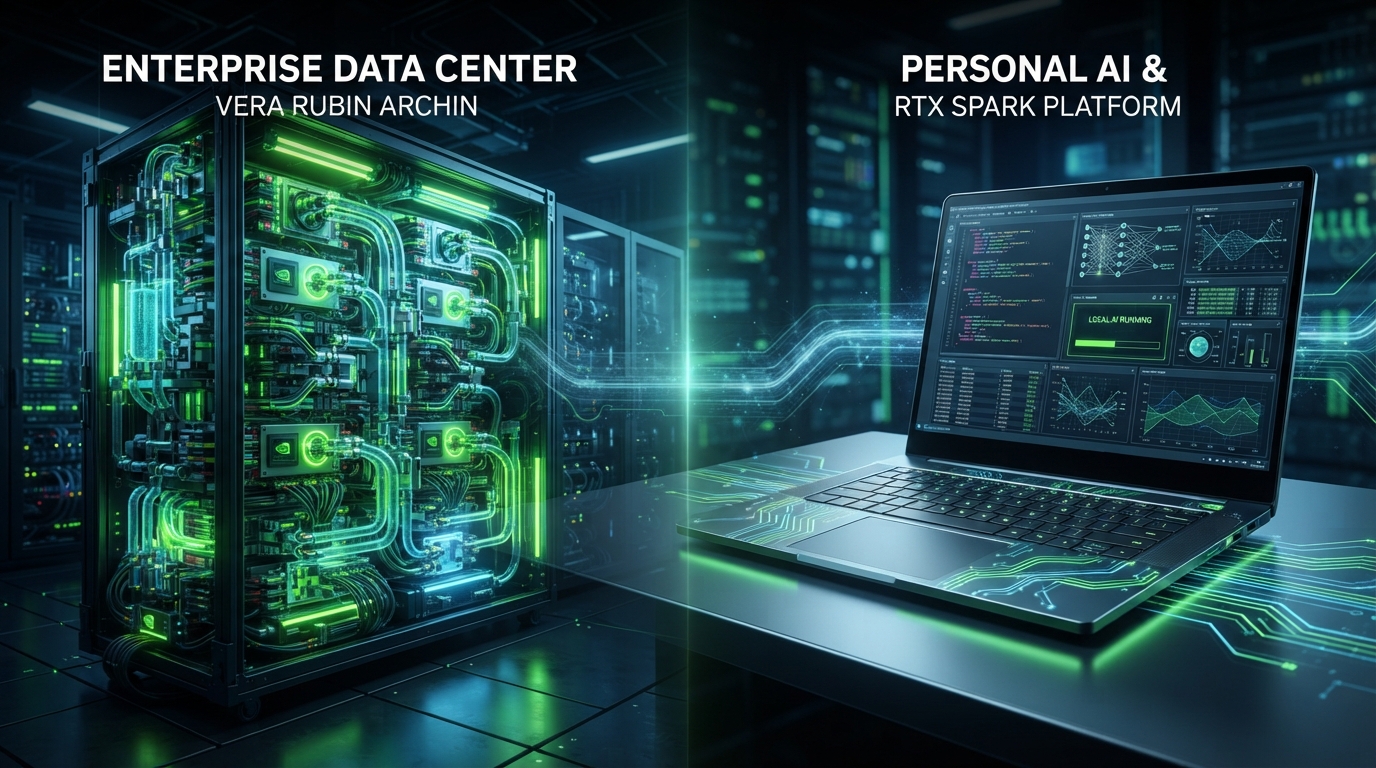
The race for artificial intelligence supremacy isn't just being fought with smarter code and larger datasets—it is being fought in silicon. As artificial intelligence transitions from simple chatbots to autonomous, reasoning agents, the hardware demands have skyrocketed. NVIDIA has responded by launching two groundbreaking GPU architectures designed to power the next era of computing: NVIDIA Vera Rubin for cloud-scale data centers, and the NVIDIA RTX Spark platform for on-device consumer AI.
Here is a deep dive into how these new architectures work, what makes them revolutionary, and how they will change the landscape of technology.
Data Center & Enterprise AI: The NVIDIA Vera Rubin Architecture
Following the massive commercial success of the Blackwell platform, NVIDIA’s new flagship data center architecture is named after the pioneering astronomer Vera Rubin. While previous generations focused heavily on raw floating-point calculations (FLOPS) to train frontier Large Language Models (LLMs), the Rubin architecture is purpose-built for Agentic AI.
Agentic AI refers to systems that don't just predict the next word, but continuously reason, execute multi-step planning, utilize external software tools, and manage massive context windows over long periods. To make this possible, NVIDIA focused on shattering the greatest bottleneck in modern computing: the memory wall.
1. Massive Memory Bandwidth via HBM4
As AI models scale to trillions of parameters and transition to Mixture-of-Experts (MoE) architectures, the speed at which a GPU can pull data from memory becomes critical. The Rubin GPU adopts next-generation HBM4 memory, unlocking a staggering 22 TB/s of memory bandwidth per chip. This represents a near 3x leap over Blackwell, allowing complex agentic workflows to retrieve context instantly without processing delays.
2. The Vera CPU Partnership
To truly optimize data flow, NVIDIA paired the Rubin GPU with a custom, Arm-based companion: the Vera CPU. Instead of routing data through generic server processors, the Vera CPU and Rubin GPU communicate bidirectionally over a blazing-fast 1.8 TB/s NVLink-C2C interface. This enables the CPU to read GPU memory almost instantly, allowing the system to handle millions of tokens in a conversation window without breaking a sweat.
3. Hyper-Scale Compute Density: The NVL72 Rack
NVIDIA isn't just selling individual chips; they are building modular supercomputers. In its full deployment configuration—the liquid-cooled Vera Rubin NVL72 rack—NVIDIA tightly couples 72 Rubin GPUs and 36 Vera CPUs using fifth-generation NVLink switches. To data center operators, the entire rack behaves as one single, colossal supercomputer, offering up to 10x more agentic AI throughput per unit of energy compared to the previous generation.
Consumer & Personal AI: The NVIDIA RTX Spark Platform
While the cloud handles massive foundational training, the demand for local, private, and offline AI has surged. For software developers, creative professionals, and tech enthusiasts who want to run advanced AI models natively, NVIDIA introduced the RTX Spark platform.
Historically, running advanced AI locally meant compromising on model size or speed. RTX Spark changes this by shrinking data-center class engineering down into a premium laptop form factor.
1. Data-Center DNA in a Laptop
Manufactured on an advanced TSMC 3nm process, the RTX Spark system-on-a-chip (SoC) bridges the gap between desktop performance and mobile efficiency. It tightly packs a mobile RTX Blackwell GPU (featuring 6,144 CUDA cores) alongside a highly efficient 20-core Grace CPU onto a single, unified superchip.
2. 128GB Unified Memory: Desktop Power Goes Mobile
The true standout feature of the RTX Spark platform is its integration of up to 128 GB of unified LPDDR5X memory. By sharing a massive memory pool across the CPU and GPU, RTX Spark allows high-end Windows laptops to run 120-billion-parameter LLMs completely offline. Users can process local code repositories, long documents, or complex creative assets across 1-million-token context windows with zero reliance on cloud subscriptions or internet connectivity.
The Big Picture: A Two-Pronged AI Future
NVIDIA’s latest hardware rollout clarifies their vision for the future of technology. By split-targeting the enterprise cloud and the local consumer device, they are building a seamless ecosystem for the next generation of software:
- In the Cloud: The Vera Rubin architecture provides the raw power, massive bandwidth, and energy efficiency required by tech giants to train frontier AI models and run massive agent networks simultaneously.
- On the Horizon: The RTX Spark platform democratizes this power, giving developers and creators the ability to run personal, highly private, secure local agents directly from their laptops.
As Agentic AI continues to reshape industries, NVIDIA’s latest silicon ensures they remain the standard foundation powering the revolution. Whether in a massive liquid-cooled data center or inside a sleek creator laptop, the future of compute has officially arrived.